Tactics to Improve Your Google Maps Ranking Without Paid Ads
Expert Strategies for Google Business Profile SEO to Dominate Local Search
In the hyper-competitive world of local search, appearing in the Local 3-Pack isn’t just an advantage – it’s the lifeblood of your business. For most local service providers, from plumbers in Riverside to HVAC contractors in Southern California, the goal is clear: you want to rank higher on google maps without burning your entire marketing budget on expensive Google Ads. As a Google Business Profile (GBP) Product Expert, I have seen firsthand how a well-executed google business profile seo strategy can transform a struggling local business into a market leader. The reality is that the Google Local 3-Pack receives between 40% and 50% of total clicks for searches with local intent. If you aren’t visible there, you are effectively handing half of your potential customers to your competitors.
Winning the local search game requires a deep understanding of the three pillars of local ranking: Proximity, Relevance, and Prominence. Proximity refers to how close the searcher is to your business location. While you cannot change your physical address, you can significantly influence Relevance (how well your profile matches the search query) and Prominence (how well-known and authoritative your business is in the eyes of Google). By focusing on organic tactics rather than paid shortcuts, you build a sustainable foundation that generates leads 24/7. To achieve this, you must Master Riverside SEO: Unlock Local Visibility & Grow Business through a systematic approach to your digital presence.
The Foundation: Strategic Google Business Profile Optimization
The first step in any successful local campaign is a comprehensive google business profile optimization. Many business owners treat their GBP as a “set it and forget it” directory listing, but as a Product Expert, I can tell you that Google treats it as a dynamic asset. A complete and optimized profile makes a business 2.7x more likely to be considered reputable by consumers. This starts with your primary category selection. Your primary category carries the most weight in the algorithm. If you are a general contractor who specializes in roofing, choosing “Roofer” as your primary category is far more effective than “General Contractor.”
Beyond the primary category, you must strategically “stack” secondary categories. For a plumbing company, this might include “Drain service,” “Heating contractor,” and “Repair service.” However, the mistake many make is over-optimizing by adding irrelevant categories, which can dilute your relevance. You should also utilize the “Services” and “Attributes” sections to their fullest extent. Google uses the text within your services to understand the nuances of what you offer. If you provide “24/7 emergency pipe repair,” that specific phrase should be in your service descriptions. Using a professional google business profile optimization tool can help you identify which attributes your top-ranking competitors are using so you can match and exceed their efforts.
Don’t overlook the “From the Business” description. While Google has stated that the keywords in this section don’t directly impact rankings, they do impact click-through rates (CTR). A compelling description that highlights your unique selling proposition (USP) and includes your service areas can encourage users to click, and high CTR is a powerful behavioral signal that tells Google your result is relevant. Regularly updating your profile with GBP Posts – sharing offers, news, and project updates – signals to Google that your business is active and engaged with the community, which is a key component of the relevance pillar.
Mastering the Review Ecosystem for Maximum Impact
Reviews are perhaps the most visible ranking factor for potential customers. Research shows that 98% of consumers read online reviews for local businesses before making a decision. However, from a google business profile seo perspective, it isn’t just about the number of stars; it is about Review Velocity and Review Diversity. Review Velocity refers to the consistency with which you receive new reviews. A business that received 100 reviews three years ago but none in the last six months will likely be outranked by a competitor who receives three reviews every week. Google’s algorithm prioritizes fresh, recent data.
Review Diversity involves the specific keywords used by your customers in their feedback. When a customer writes, “The best emergency plumber in Riverside helped me with a water leak,” they are providing Google with high-value keyword associations. You can subtly encourage this by asking customers to mention the specific service they received. To stay ahead, you need a robust google review strategy that automates the request process and ensures you are consistently generating fresh content. For more tips on how to fine-tune these elements, check out these 5 Simple Google Business Profile Tweaks That Boost Maps Visibility.
Responding to every review – both positive and negative – is mandatory. When you respond, you demonstrate to both Google and potential customers that you are attentive. Pro-tip: Include natural variations of your keywords in your responses. If a customer praises your HVAC repair, respond with, “Thank you for the review! We take pride in providing the most reliable HVAC repair in the area.” This reinforces your relevance for those specific terms. Remember, the review section is a two-way conversation that builds the “Prominence” pillar of your local ranking strategy.
Local Citations and the Power of NAP Consistency
Citations are mentions of your business’s Name, Address, and Phone number (NAP) across the web. For years, the mantra was “the more, the better,” but the landscape has shifted. While having your business listed on major aggregators like Yelp, Yellow Pages, and Bing is still necessary, the weight of generic directory listings has decreased. Today, “unstructured citations” – mentions of your business on local news sites, neighborhood blogs, or community event pages – are significantly more powerful. These signals tell Google that you are a legitimate part of the local fabric, which directly boosts your prominence.
The golden rule of citations remains NAP consistency. If your address is “123 Main St Ste 4” on your GBP but “123 Main Street #4” on a local directory, Google may view these as two different entities, or at the very least, it creates a “data conflict” that reduces their confidence in your location. This lack of confidence can suppress your rankings in the Map Pack. Utilizing professional citation building services can help you audit your existing mentions and clean up any inconsistencies that might be holding you back. Consistency across the digital landscape ensures that Google’s “knowledge graph” for your business is clear and authoritative.
Think beyond the standard directories. Are you a member of the local Chamber of Commerce? Is your business listed on the website of a local Little League team you sponsored? These hyperlocal links and citations are incredibly difficult for competitors to replicate. They provide a level of geographic relevance that a generic directory listing simply cannot match. In the eyes of the algorithm, a mention from a trusted local source is worth more than a dozen mentions from low-quality, global directories.
On-Page SEO: The Bridge to Local Prominence
Many business owners fail to realize that their website’s organic ranking directly influences their Google Maps ranking. In fact, on-page signals are the “bridge” that connects your website’s authority to your Google Business Profile. While GBP signals account for approximately 30-35% of ranking factors, your website’s SEO health provides the context Google needs to rank you for complex queries. This is why implementing Southern California SEO Strategies to Dominate Your Market is essential for anyone looking to win the long-term local SEO game.
A hyperlocal content strategy is the most effective way to strengthen this bridge. Instead of just having a “Services” page, create dedicated “City Pages” or “Service Area Pages.” If you are a roofer based in Riverside but you serve Corona, Moreno Valley, and Jurupa Valley, each of those cities deserves a dedicated page. These pages shouldn’t just be clones of each other with the city name swapped out; they should include local landmarks, neighborhood names, and specific projects you’ve completed in those areas. This depth of content signals to Google that you are an authority in those specific geographic zones, helping you rank higher on google maps even when the searcher is further from your physical office.
Technical on-page elements also play a role. Ensure your NAP is clearly visible in the footer of every page, and use Local Business Schema Markup (JSON-LD) to explicitly tell search engines your business name, address, phone number, and operating hours. This structured data removes any ambiguity for Google’s crawlers. When your website and your GBP are perfectly synced, Google gains the confidence necessary to place you at the top of the search results for highly competitive local terms.
Advanced Tactics: Local Backlinks and Map Embeds
Once the foundation is set, it’s time to move into advanced tactics that separate the leaders from the pack. Local link building is one of the most underutilized strategies in google business profile seo. While traditional SEO focuses on high-authority “DR” (Domain Rating) links, local SEO thrives on “Geographic Authority.” A link from a local high school, a neighborhood association, or a local news outlet carries immense weight for your Map Pack ranking. These links confirm your physical presence and community involvement, which are key indicators of prominence.
Another technical tactic is the strategic use of Google Map embeds. You should embed your actual Google Business Profile map (not just a static image) on your “Contact Us” and “Location” pages. This creates a direct API link between your website and your GBP. It allows users to interact with the map – getting directions or reading reviews – without leaving your site. These interactions are behavioral signals that Google tracks. If you are looking for a comprehensive google maps ranking service, you should look for one that emphasizes these types of technical integrations over simple keyword stuffing. For a deeper look at how this works in practice, explore Maps Optimization in Riverside: Boost Your Local Search Presence.
Furthermore, consider the power of “Brand Mentions.” Even if a local website doesn’t link to you, a mention of your business name alongside your city and service can act as a “co-occurrence” signal. Google’s algorithm is sophisticated enough to associate your brand with specific keywords and locations based on how often they appear together across the web. Sponsoring local events or being featured in a “Best of [City]” list are excellent ways to generate these mentions organically.
Auditing and Tracking: How to Measure Your Success
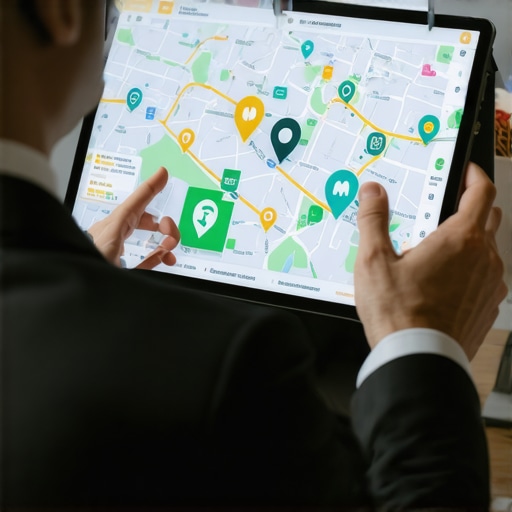
You cannot fix what you do not measure. Traditional rank trackers that show you a single ranking for a city are often misleading because local rankings are highly granular. A business might rank #1 when the searcher is standing in their parking lot, but drop to #10 just two blocks away. This is why using a sophisticated google business profile audit tool or a geogrid rank tracker is vital. These tools provide a visual map showing your ranking at specific points across your entire service area.
By using a geogrid tracker, you can identify “ranking dead zones.” If you see that your visibility drops off sharply to the north, you can adjust your content strategy to include more mentions of those specific northern neighborhoods or seek out local backlinks from that area. Monitoring your GBP Insights is also crucial. Pay close attention to “Discovery” searches versus “Direct” searches. An increase in discovery searches means your SEO efforts are working – people who didn’t know your business name are finding you based on the services you provide. Tracking “Phone Calls,” “Direction Requests,” and “Website Visits” from your GBP provides the ultimate proof of ROI for your local SEO efforts.
Regular audits should also include checking for “suggested edits” on your profile. Competitors or well-meaning users can suggest changes to your hours, website, or even your business name. If you aren’t monitoring your profile, these changes can be auto-applied, potentially damaging your rankings or misleading your customers. Staying proactive with your data ensures that your profile remains the “source of truth” for Google and your clients alike.
Conclusion: The Marathon of Local SEO
Achieving a top spot in the Google Maps 3-Pack without paid ads is a marathon, not a sprint. It requires a consistent commitment to the three pillars of Proximity, Relevance, and Prominence. By optimizing your profile, managing your review ecosystem, ensuring NAP consistency, and bridging the gap with on-page SEO, you create a dominant digital presence that outlasts any temporary ad campaign. The rewards – increased trust, higher click-through rates, and a steady stream of local leads – are well worth the effort.
If you are ready to stop guessing and start growing, now is the time to take action. Whether you choose to implement these tactics yourself or partner with an expert, the path to the top of Google Maps is clear. For a professional deep-dive into your current standing, Contact Us today for a comprehensive local SEO audit. Let’s work together to make your business the most prominent name in your local market.