
6 Specific Tactics to Audit Your Riverside Competitors’ Google Profiles
6 Specific Tactics to Audit Your Riverside Competitors’ Google Profiles
I. Introduction: The Riverside Map Pack Battlefield
In the heart of the Inland Empire, Riverside’s local economy is no longer a sleeper market. With massive moves like the $24.5 million Riverside Unified School District acquisition and the explosive growth in the healthcare and advanced manufacturing sectors, the digital landscape has become hyper-competitive. For a local business, appearing in the “Map Pack” – those top three spots on Google Maps – is no longer a luxury; it is a prerequisite for survival. If you aren’t there, your competitors are eating your lunch, breakfast, and dinner.
As a Local SEO Specialist, I often see Riverside business owners frustrated because they have a “better” business than the guy at the top of the search results. They have better service, better prices, and a more professional team. But Google doesn’t rank you based on your character; it ranks you based on proximity, relevance, and prominence. While you can’t change your physical location easily, you can absolutely manipulate relevance and prominence by systematically dismantling your competition’s strategy.
The Riverside-San Bernardino-Ontario Metropolitan Statistical Area (MSA) is one of the fastest-growing regions in California. This growth brings a flood of new businesses all vying for the same “near me” searches. To win, you must stop guessing and start auditing. This guide will walk you through six data-driven tactics to audit your Riverside competitors’ Google Business Profiles (GBP) and build a roadmap to the #1 spot.
II. Tactic 1: Category Spying – Uncovering the Primary & Secondary Labels
When you look at a competitor’s Google Business Profile in the search results, Google only shows you their “Primary Category.” For example, a local contractor might be listed as a “Plumber.” However, Google allows businesses to select one primary category and up to nine secondary categories. These secondary categories are the hidden engines driving their visibility across a wide range of keywords.
If you want to rank google business profile listings effectively, you must know exactly which categories the market leaders are using. A Riverside plumber might have “Plumber” as their primary label but could be capturing massive traffic by using secondary categories like “Heating Equipment Supplier,” “Drainage Service,” or “Air Conditioning Repair.” If you only have “Plumber” selected, you are essentially fighting with one hand tied behind your back.
To audit this, I recommend using google business profile seo tools like PlePer or GMB Everywhere. These browser extensions allow you to see the full list of categories any business is using. When you audit the top three businesses in the Riverside map pack for your niche, look for the “Category Gap.” If all three leaders are using “Water Heater Repair Service” and you aren’t, that is your first immediate optimization task. Aligning your categories with the successful competitors is the fastest way to signal relevance to Google’s algorithm.
III. Tactic 2: Geo-Grid Mapping – Visualizing the “Dead Zones”
One of the biggest mistakes Riverside business owners make is checking their rankings from their own office. Because of proximity-based ranking, you will almost always appear #1 when you are standing in your own parking lot. But how do you rank in Canyon Crest? What about La Sierra or Orangecrest? To truly understand your competition, you need to see the “Geo-Grid.”
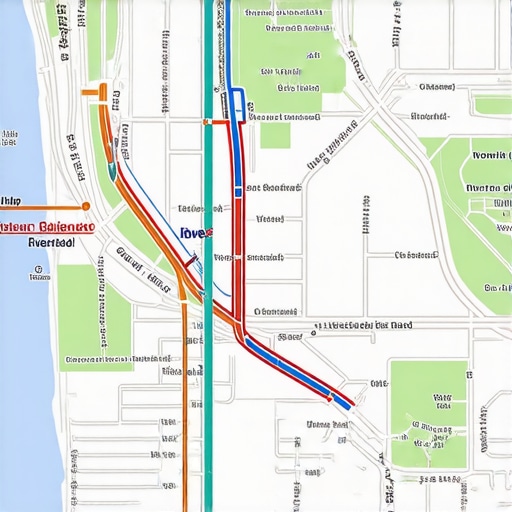
Using a google maps rank tracker, you can visualize your rankings (and your competitors’ rankings) across a map of Riverside. This tool places a grid over the city and performs a search at every intersection of that grid. You might find that your main competitor dominates the downtown area but their rankings fall off a cliff once you cross the 91 freeway into the Woodcrest area.
These “dead zones” are your greatest opportunity. By identifying where a competitor is weak, you can tailor your local SEO strategy to capture that specific geographic territory. If a competitor ranks #1 at their physical location but drops to #10 just two miles away, it suggests their “prominence” is low. You can exploit this by building local citations and location-specific content that targets those neighborhoods, effectively pushing your “ranking bubble” into their territory.
IV. Tactic 3: Review Velocity & Sentiment Gap Analysis
Most people look at the total number of reviews and assume that the business with the most stars wins. While volume matters, Google’s algorithm places a heavy emphasis on Review Velocity (how often you get new reviews) and Review Recency. If a Riverside law firm has 500 reviews but hasn’t received a new one in three months, they are vulnerable to a competitor who is getting five reviews a week.
When auditing your Riverside competitors, don’t just look at the number. Calculate their monthly velocity. If the top-ranked chiropractor in Riverside is averaging 10 reviews a month, your goal must be to hit 12 or 15. Furthermore, perform a “Sentiment Gap Analysis.” Look at their negative reviews. Are customers complaining about long wait times at their Riverside clinic? Use that information in your own profile. Highlight your “Fast Check-in” or “No-Wait Guarantee” in your business description and Google Posts.
According to recent industry research from Search Engine Land, Google also scans review text for keywords. Audit your competitors to see if their customers are naturally using your target keywords (e.g., “best personal injury lawyer in Riverside”). If they are, you need to implement a review acquisition strategy that encourages your clients to mention specific services and locations in their feedback. This builds the “prominence” factor that Google craves.
V. Tactic 4: The Q&A “Keyword Stuffing” Audit
The “Questions & Answers” section of a Google Business Profile is often ignored by business owners, but it is a goldmine for local seo ranking tools and strategy. Did you know that anyone can ask a question, and the business owner can answer it? More importantly, did you know that the business owner can ask their own questions?
Audit your Riverside competitors to see if they are “seeding” their Q&A section. A savvy competitor will ask, “Do you provide emergency AC repair in Riverside?” and then answer it themselves with a detailed response that includes secondary keywords. This section is indexed by Google and contributes to your profile’s overall relevance.
If your competitors have an empty Q&A section, this is a massive gap you can fill. By using google maps seo tools to identify high-volume long-tail keywords, you can create a robust FAQ section on your own profile. This not only helps with ranking but also increases conversion by answering potential customers’ questions before they even pick up the phone. If a competitor is doing this, look for keywords they’ve missed – perhaps they mentioned “Riverside” but forgot to mention “Inland Empire” or specific neighborhoods like “Mission Grove.”
VI. Tactic 5: Service Area & Proximity Stress-Testing
In the world of Local SEO, “spam” is a constant battle. Many businesses in the Riverside area attempt to game the system by creating fake profiles or using virtual offices (like a Regus suite or a UPS Store) to appear closer to the city center. This is a direct violation of Google’s Terms of Service.
As part of your audit, you should use a google business profile audit tool to stress-test the physical locations of your competitors. For Service Area Businesses (SABs) that hide their address, you can often find their “hidden” location by looking at historical data or cross-referencing their business license with the City of Riverside’s public records.
If you find a competitor is using a residential address but has a “permanent office” sign in their photos, or if they are using a PO Box to rank in a neighborhood where they have no physical presence, you have the right to “Suggest an Edit” or file a Redressal Complaint. Cleaning up the map by removing fraudulent listings is one of the most effective ways to improve google maps rankings for legitimate local businesses. Don’t let “ghost” offices steal your leads.
VII. Tactic 6: Content Frequency & Post Engagement
Google Business Profile “Updates” (formerly Google Posts) are essentially micro-blogging for local businesses. While they may not be a direct ranking factor in the traditional sense, they significantly impact your “freshness” score and click-through rate (CTR). A profile that is updated weekly signals to Google that the business is active and engaged.
Audit the posting frequency of your top three Riverside competitors. Are they posting at all? If they are, what is the content? Are they just posting generic stock photos, or are they sharing “behind the scenes” photos of their team working in Riverside? Real, geo-tagged photos from your job sites in the Inland Empire are worth ten times more than a professional stock photo.
If your competitors haven’t posted in three months, you have a clear path to dominance. By posting 2-3 times a week with high-quality images and keyword-rich captions, you increase the “real estate” your profile takes up on the search results page. This higher engagement leads to more clicks, and more clicks lead to higher rankings. It’s a virtuous cycle that starts with a simple audit of the competition’s laziness.
VIII. Conclusion: The Path to #1
Auditing your Riverside competitors is the first step toward total market dominance. By systematically identifying their categories, mapping their geo-grids, analyzing their review velocity, and exposing their Q&A or location weaknesses, you move from a defensive posture to an offensive one. You aren’t just “optimizing your profile”; you are engineered to out-perform the current leaders.
In my experience tracking geo-grids in Southern California, the businesses that win are the ones that treat their Google Business Profile as a living asset, not a “set it and forget it” directory listing. If you’re ready to take the next step and need a professional google business profile audit tool or a comprehensive strategy, I’m here to help. Or, if you’re a do-it-yourselfer, head over to SEO Viper Tools to get the data you need to start your climb to the top of the Riverside Map Pack today.